About Montessori
About Montessori
-F.A.Q: Who is Maria Montessori
-F.A.Q: The Montessori Philosophy
-F.A.Q: The Montessori Method
-F.A.Q: Age ranges
Maria Montessori was born in Italy on August 31, 1870. She was born to a well-respected family and was expected to grow up to fulfil the traditional role of the Italian woman. Instead she pursued an advanced degree at the University of Rome and became the first woman physician to graduate in Italy. Her interests drew her to work with children, initially those who were disadvantaged and had special needs.
Because she was an anthropologist, Montessori's decisions about working with children were made by observing them first. She was not trained as an educator and thus her decisions were based upon watching what children did and what they were attracted to. Through her observations and trial and error, she developed what became known as the Montessori Method of education.
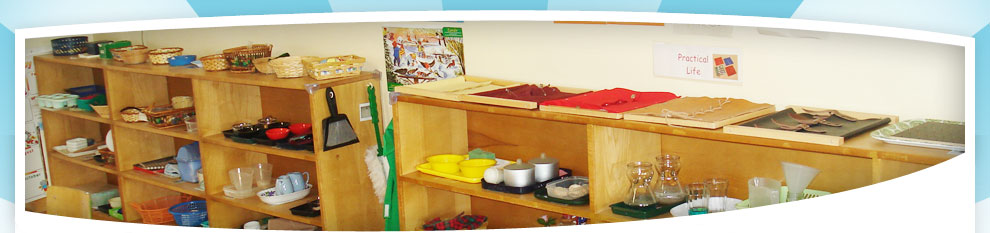
It was a radical departure in Montessori's own time. Montessori did not place children in restricting environments, but instead designed the environments to reflect the children. Tables and chairs were child-sized and materials were placed low on the shelves to be readily accessible to the students. In addition, many of the skills were designed to teach children how to become more independent and do things for themselves.
Montessori continued throughout her life to work for the betterment of the lives of children, founding training centres for teachers and dispersing this method of education throughout the world. During her later years her focus became centred on educating children to promote the principles of peace. Her legacy has been the establishment of Montessori schools around the world, which promote the cause of the child as a citizen of the world.
Dr. Montessori observed that children have an innate desire to explore and learn about their world. The curriculum and teaching method she developed were designed to appeal to and nurture the child’s basic desire to learn.
Many parents are attracted to Montessori because of the amount children learn at an early age. After spending three years in the Primary environment, a child is typically reading, writing, adding and subtracting, and naming continents and countries on the globe. However, the more significant value of a Montessori education lies in the often-overlooked aspects of a child’s development that prepare them for full participation in our society.
In the Montessori Program children progress at their own rates in multi-aged
classes of 3 - 6, 6 - 9 and 9 - 12 year olds. Children with special interests
and/or abilities can forge ahead as far and as fast as they want without
being held back by other children or grade level curriculum limitations.
Other children in the class learn from and are motivated by their association
with the high achievers. In the non-competitive atmosphere of Montessori
classes where students are not judged in relation to each other, the children
are free to like each other, to appreciate the accomplishments of their
classmates, and to cooperate with each other's educational endeavours.
Each class becomes a cooperative community.
Montessori discovered that children have sensitive periods or critical
learning periods that are age specific. During each of these periods,
children exhibit a burning interest in specific kinds of activities and
the acquisition of specific knowledge and skills. Montessori provides
opportunities to engage in activities, which match specific sensitive
periods. Children are presented with a number of different materials and
activities appropriate to their sensitive periods and are given the opportunity
to choose from among them. They follow their inner directives and choose
activities, which fulfil the needs of these periods. In the process, they
learn to make choices and to make constructive use of their time. The
students stay in touch with their innate desire to learn and pursue activities
and topics of interest further than would be required in a regular school
setting. Thus an ability to work independently and a love of learning
are established. The students become independent thinkers, capable of
making decisions and pursuing knowledge on their own. These are attributes,
which enhance quality of life and are especially important in the development
of future leaders.
The span of age range is from 2½ - 6 years and is very important in the Montessori Classroom because younger children observe older children and older children learn to empathise with younger children. Children learn concentration, order, sequence and skills adapted to their culture with Practical Life materials. They increase the acuity of their senses and gain an understanding of the nuances of abstract terms such as large and small with the Sensorial materials. Language activities and materials increase vocabulary and conversational skills, develop writing and reading skills, and begin an understanding of grammar. Hands-on experiences with the math materials give children clear concrete impressions on which to build their own abstractions. Additional components include language experiences with geographical concepts, peoples of the world, simple science experiments, botany, zoology, art and music.

